While much of the digital asset industry remains focused on the latest developments surrounding the CLARITY Act and federal market structure negotiations in Washington D.C., a potentially significant development may be flying under the radar for cryptocurrency companies operating in California.
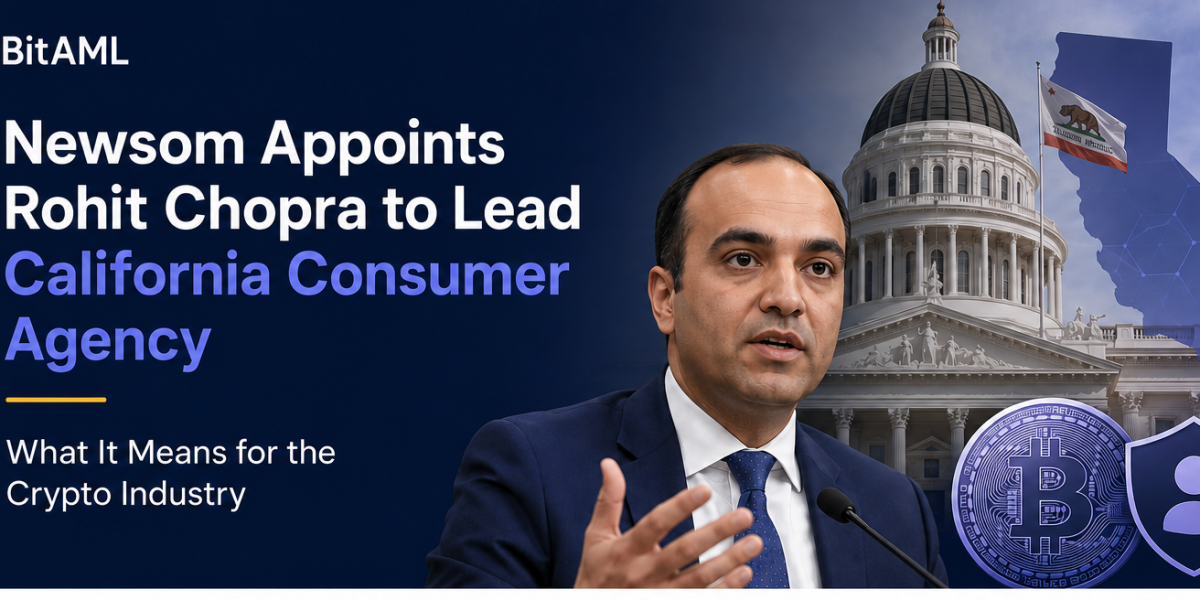
Earlier this week, Governor Gavin Newsom announced the appointment of former Consumer Financial Protection Bureau (CFPB) Director Rohit Chopra to lead California’s newly formed Business and Consumer Services Agency (BCSA), a sweeping new state-level consumer protection and business oversight agency set to launch on July 1, 2026.
For the crypto industry, the appointment is notable not only because of Chopra’s national profile, but because it may signal California’s intention to take a far more assertive role in consumer protection, financial technology oversight, privacy, and digital financial asset regulation in the years ahead.
What Is California’s New Business and Consumer Services Agency?
The newly created BCSA is part of Governor Newsom’s broader executive branch reorganization effort. The agency will consolidate oversight and enforcement responsibilities across a wide range of California departments and regulatory bodies focused on consumer protection, licensing, privacy, and business oversight, according to the Governor’s Office.
Importantly for the digital asset sector, the agency’s orbit is expected to include entities and regulatory functions closely tied to:
- Financial Services Oversight
- Consumer Protection
- Online Privacy
- Data Practices
- Licensing and Enforcement
- Potential Implementation and Supervision of California’s Digital Financial Assets Law (DFAL)
While the California Department of Financial Protection and Innovation (DFPI) already serves as the state’s primary digital asset regulator, the broader consolidation of consumer and business enforcement functions under a Chopra-led agency could create a more coordinated and aggressive regulatory environment for financial technology and cryptocurrency businesses operating in California.
Why Rohit Chopra Matters
Rohit Chopra is not a traditional regulator. Throughout his tenure at the CFPB and Federal Trade Commission (FTC), Chopra established a reputation as one of the country’s most assertive consumer protection advocates.
He is widely viewed as a close ally and former protégé of Senator Elizabeth Warren, one of the cryptocurrency industry’s most outspoken critics. Chopra previously worked alongside Warren during the formation of the CFPB and later earned praise from her following his nomination to lead the bureau.
At the CFPB, Chopra frequently emphasized:
- Stronger Oversight of Financial Institutions
- Heightened Scrutiny of Fintech Companies
- Aggressive Enforcement Approaches
- Consumer Fee Transparency
- Privacy Protections
- Emerging Payment Technologies and Big Tech Expansion
Notably, during his time at CFPB, Chopra scrutinized digital payments ecosystems involving major technology companies and platforms such as PayPal and Block (Square).
What Could This Mean for Crypto?
To be clear, Chopra’s appointment does not necessarily signal an imminent crackdown on the digital asset industry. California has simultaneously demonstrated a willingness to support innovation, attract emerging technology sectors, and establish clearer regulatory frameworks such as DFAL.
However, the appointment does suggest several potential developments the industry should monitor closely.
- Increased Focus on Consumer Protection
California regulators have already demonstrated growing concern around:
- Crypto scams
- Kiosk fraud
- Misleading advertising
- Fees and disclosures
- Stablecoins
- Retail consumer protections
Under Chopra’s leadership, California may place even greater emphasis on:
- Consumer disclosures
- Complaint handling
- Fee transparency
- Marketing practices
- Onboarding suitability
- Fraud prevention controls
- Scam mitigation frameworks
This trend is already visible nationally as states adopt increasingly prescriptive cryptocurrency kiosk regulations, transaction warnings, refund requirements, and scam-prevention obligations.
- Greater Scrutiny of Fintech and Payments
Chopra has consistently expressed concern regarding the convergence of technology companies and financial services.
For crypto firms, particularly those operating in:
- Payments
- Stablecoins
- Wallets
- Embedded finance
- AI-Driven financial products
- Consumer-facing applications
California may become more active in examining operational practices, disclosures, customer treatment, and systemic consumer risks.
- Privacy and Data Governance Could Become Bigger Issues
California already maintains some of the strongest consumer privacy laws in the country through the California Consumer Privacy Act (CCPA) and California Privacy Rights Act (CPRA).
Given Chopra’s historical interest in data practices and consumer financial data usage, crypto companies may face heightened scrutiny around:
- Wallet analytics
- Behavioral profiling
- AI usage
- Data sharing
- Advertising practices
- Consumer consent frameworks
This could be particularly important for companies leveraging blockchain analytics, behavioral risk scoring, targeted advertising, or AI-enhanced compliance tooling.
A Potentially Important Shift Flying Under the Radar
At the moment, most industry attention remains fixed on Washington D.C., where Congress continues debating the CLARITY Act, stablecoin legislation, and broader federal crypto market structure reform.
Yet California remains one of the world’s largest economies and one of the most influential state regulatory jurisdictions in the United States. The appointment of a nationally prominent consumer protection regulator with a history of aggressive financial oversight should not be overlooked by the digital asset sector.
Whether this ultimately results in stronger consumer confidence and clearer operational expectations — or a more challenging compliance environment — will likely depend on how California balances innovation with consumer safeguards in the years ahead.
For now, crypto companies operating in or servicing California residents would be wise to pay close attention.
Final Thoughts
The digital asset industry has long debated whether regulatory clarity alone is sufficient to ensure long-term adoption and trust. Increasingly, the conversation is shifting toward consumer protection, operational integrity, disclosures, and responsible innovation.
Rohit Chopra’s appointment may prove to be an important signal that California intends to play a larger role in shaping that next chapter.
What Should Crypto Companies Do Now?
For cryptocurrency companies operating in or servicing California residents, now is the time to proactively evaluate whether your compliance program, consumer protection controls, disclosures, complaint-handling procedures, marketing practices, and fraud prevention frameworks are truly prepared for the next phase of state-level oversight.
The regulatory conversation is evolving quickly — and increasingly beyond traditional AML compliance alone.
Organizations that invest early in strong governance, operational transparency, consumer safeguards, and scalable compliance infrastructure will be far better positioned to navigate California’s rapidly evolving regulatory environment and build long-term trust with regulators, banking partners, and customers alike.
BitAML continues to actively monitor developments surrounding California’s Digital Financial Assets Law (DFAL), consumer protection trends, cryptocurrency kiosk regulation, stablecoins, blockchain analytics, and broader digital asset policy developments at both the state and federal levels.
If your organization would like to discuss how these developments may impact your business, licensing strategy, compliance program, or operational risk framework, contact BitAML to schedule a consultation with our team.