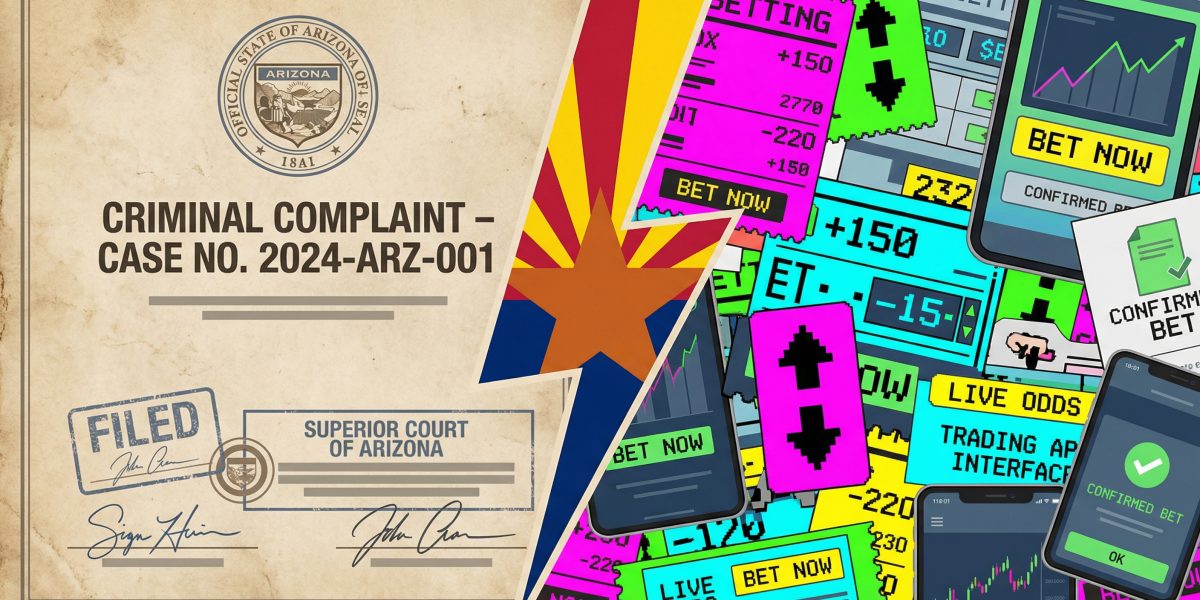
A Turning Point—Not Just Another Enforcement Action
Until now, most of the conversation around prediction markets has lived in a gray, almost theoretical space.
Are they even contracts?
Are they gambling?
All of the above? None of the above?
Who regulates them?
This week, that debate took a sharp turn into reality.
Arizona became the first state to file criminal charges (yes, criminal charges) against a prediction market platform. The state’s Attorney General accused one of the world’s largest prediction markets, Kalshi, of operating an illegal gambling business and accepting bets on elections—both prohibited under state law.
That alone is significant.
But what makes this moment different is not just the charges—it’s what they represent. This isn’t just regulation catching up. It’s enforcement stepping in.
From Innovation to Enforcement
Prediction markets have been evolving quickly—arguably faster than the frameworks meant to govern them.
As we explored in Betting on the Future: The Rise of Prediction Markets (Part 1), these platforms have transformed from niche experiments into real-time indicators of public sentiment, allowing users to trade on the probability of real-world outcomes.
But that growth hasn’t come with clear boundaries.
Instead, it has exposed a fundamental tension: these platforms don’t fit neatly into existing categories. They resemble financial markets in structure, but often behave like betting platforms in practice.
What we’re seeing now is the natural next step.
When innovation outpaces clarity, enforcement fills the gap.
Arizona Brings Criminal Charges in a First-of-Its-Kind Move
Arizona’s case against Kalshi marks a dramatic escalation.
Kalshi may brand itself as a ‘prediction market,’ but what it’s actually doing is running an illegal gambling operation.”
— Kris Mayes, Arizona Attorney General
The state filed a 20-count misdemeanor complaint, alleging that Kalshi:
- Operated an unlicensed wagering business
- Accepted bets on professional and college sports
- Allowed wagers on election outcomes
Notably, the charges are directed at the company—not individual executives—but the signal is unmistakable. States are no longer limiting themselves to cease-and-desist orders or civil actions. They’re willing to pursue criminal enforcement.
Arizona’s Attorney General framed the issue plainly: regardless of how Kalshi positions itself, the activity falls within the state’s definition of gambling—and therefore within its enforcement authority.
Kalshi, of course, disagrees.
And that disagreement leads directly to the real issue at the center of this case.
The Real Fight: Who Gets to Regulate This?
At its core, this isn’t just about Kalshi.
It’s about jurisdiction.
Kalshi operates as a federally registered and regulated derivatives exchange under the oversight of the Commodity Futures Trading Commission (CFTC), offering “event contracts” that function like derivatives tied to real-world outcomes.
From its perspective, that should settle the matter.
Federal oversight should preempt state law.
Arizona sees it differently.
The state argues that federal recognition does not override its own criminal statutes—particularly when it comes to gambling and election-related wagering.
This is where things get complicated.
Because both positions have merit.
And more importantly, both create very different futures for the industry.
If Kalshi prevails, prediction markets may operate under a national framework, guided primarily by federal regulators.
If Arizona prevails, these platforms could face a patchwork of state-by-state rules, each with its own definitions, restrictions, and enforcement approaches.
That’s not just a legal distinction.
It’s an operational one.
Why States Are Escalating Now
On the surface, the rationale is straightforward: consumer protection.
State officials have pointed to concerns around fraud, election integrity, and the potential for misuse of these platforms.
“Arizona will not be bullied into letting any company place itself above state law.”
— Kris Mayes, Arizona Attorney General
Those concerns are real.
But they’re not the whole story.
There’s also an economic layer that’s harder to ignore.
Arizona, for example, is home to a thriving tribal gaming ecosystem—generating billions in annual revenue and supporting tens of thousands of jobs. Sports betting, legalized in recent years, is tightly integrated into that system.
Prediction markets don’t just introduce a new product.
They introduce a new form of asymmetrical competition through an intuitive mobile app that resonates with a new generation less interested in the traditional experience of land-based casinos.
And not one that fits neatly within existing licensing or revenue-sharing frameworks.
Put simply:
Prediction markets aren’t entering a neutral playing field.
They’re entering markets that already have established stakeholders.
That context doesn’t invalidate enforcement actions—but it does help explain their urgency.
Why This Matters for Compliance Teams
For businesses operating in or around prediction markets, this case introduces a new level of complexity.
The issue isn’t just regulatory uncertainty anymore.
It’s regulatory conflict.
As we outlined in The Rise of Prediction Markets (Part 2), these platforms sit at the intersection of multiple regulatory regimes—financial, gaming, and even political.
Now, those regimes are beginning to actively push against one another.
That creates real risk.
- Federal compliance may not shield you from state enforcement
- Activities permissible in one jurisdiction may trigger penalties in another
- Enforcement is no longer limited to civil action—it can escalate
In other words, the margin for error is shrinking.
And the cost of getting it wrong is increasing.
What Happens Next?
The next phase of this story will likely unfold in federal court.
Kalshi has already filed suit seeking to block Arizona’s action, arguing that federal law should preempt state enforcement.
The outcome could set a powerful precedent.
Not just for Kalshi—but for the entire prediction market ecosystem.
Other states are watching closely. Some have already taken action through civil lawsuits or cease-and-desist orders.
Arizona’s move raises the stakes.
If criminal enforcement becomes part of the playbook, the industry may need to rethink how—and where—it operates.
A New Phase for Prediction Markets
Prediction markets aren’t new.
But the way they’re being treated is.
What began as a question of classification—financial product or gambling—has evolved into something more consequential:
A test of authority.
A test of jurisdiction.
And ultimately, a test of how innovation fits within existing systems.
The question is no longer whether these platforms will be regulated.
It’s who gets to decide how.
So, Do These
If your business touches prediction markets, digital assets, or emerging financial products, this moment matters.
Not just because of what is happening in Arizona—but because of what it signals moving forward.
At BitAML, we’re helping clients navigate exactly these kinds of overlapping regulatory frameworks—before they turn into enforcement actions.
If you’re thinking through how this impacts your compliance strategy, now is a good time to start that conversation.
👉 Let’s connect, book your discovery call with BitAML today.