How this Massive Seachange Went from Niche to Necessity. What Changed?
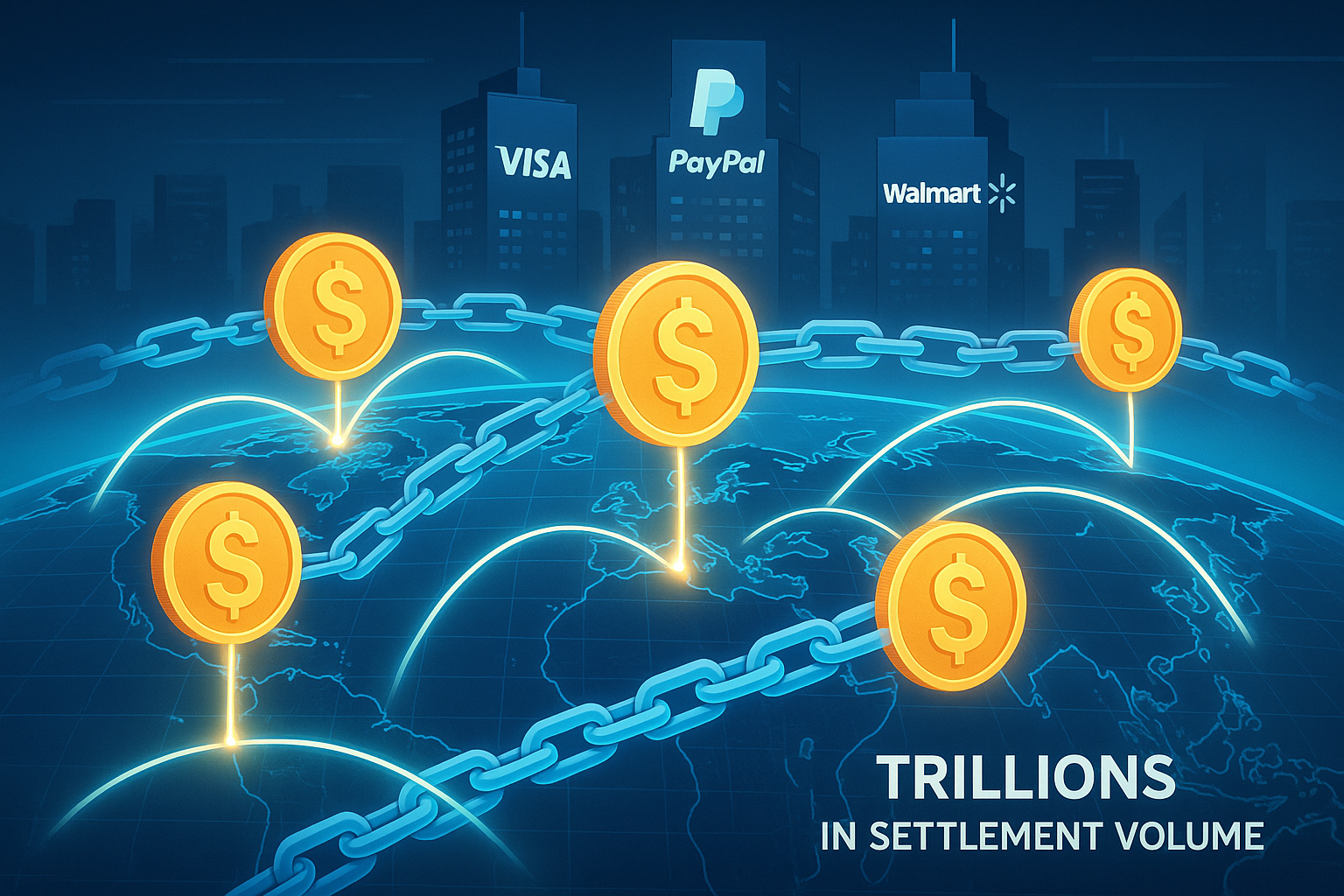
A few years ago, stablecoins were a curiosity—mainly used by traders who wanted a quick way to park value between crypto positions. Fast forward to today, and they’re handling trillions in settlement volume and showing up in the playbooks of companies you know by name.
“General growth and rate of growth, transaction volume, reach, mainstreaming… there are definitely household names getting into stablecoins—the Walmarts of the world, Visa and MasterCard, PayPal, Block (Square).”
— Joe Ciccolo, Founder & President of BitAML
In markets where currency swings can erase a week’s wages overnight, that one-to-one peg to the dollar is more than a financial instrument—it’s peace of mind. Families wiring money home now see remittance costs closer to 0.5–3% with stablecoins, compared to the 6% average charged by traditional providers.
⚡ Callout: $5.7 trillion in stablecoin transactions settled in 2024; +66% in Q1 2025.
 The Data: Growth at a Glance
Stablecoins are no longer a sidecar to the crypto economy—they are the economy in many respects. A few figures:
- $252B total market cap (mid-2025).
- USDT ≈ $112B (68% share): remarkable dominance, but represent a possible concentration risk.
- 500M+ wallet addresses now interact with stablecoins (though not all are unique individuals).
- DeFi total value locked: $123.6B, ~40% tied to stablecoins.
These numbers underscore why regulators, payment networks, and financial crime investigators alike are paying closer attention.
⚡ Callout: Tether (USDT) ≈ $112B—68% of the market.
For a full set of up-to-date stats on stablecoin market size, chain distribution, and reserve breakdowns, see CoinLaw’s “Stablecoin Statistics 2025: Growth, Adoption, and Regulation.
Worthy Lessons Learned Early with Terra Luna
The industry has scars to prove how fragile things can be. Remember Terra Luna? When the peg broke, the so-called algorithmic safety net collapsed into a reflexive death spiral. Holders of the token lost billions, and trust in “code-backed promises” evaporated.
The crash left lawmakers with a clear message: reserves matter. Algorithmic dreams gave way to reserve-backed realities. Today, centralized stablecoins account for about 90% of supply. Transparency, licensing, and redemption rules aren’t just regulatory wish lists—they’re survival tools.
Policy Alignment on the Horizon
Stablecoin policy is no longer unclear nor theoretical. It’s arriving in force across jurisdictions:
- GENIUS Act (U.S., July 2025): requires AML programs, attestations, and accounting standards for stablecoin issuers.
- California AB 39: DFPI licensing for stablecoin issuers, effective July 1, 2026.
- MiCA (EU): fully in effect, demanding licensing, reserve quality checks, and whitepapers for stablecoin issuers.
As BitAML’s Ciccolo notes:
“Other states are sure to follow California—not necessarily through legislation, but through regulatory rulemaking or enhanced expectations from regulators when engaging with licensees or the industry at large.”
The International Monetary Fund (IMF) recently warned that dollar-denominated stablecoins could speed up dollarization abroad, creating risks for local banking systems. That’s a reminder that this isn’t just about crypto—it’s about geopolitics and monetary policy.
⚡ Callout: Remittance costs ~0.5–3% vs. ~6% traditional.
If you want to dig deeper into how California’s DFAL licensing requirement may intersect with or diverge from the federal GENIUS Act, check out BitAML’s Blog comparing of these two regulatory frameworks.
Compliance Implications Beyond the Numbers
The real test isn’t whether stablecoins can move money faster or cheaper. It’s whether compliance teams can keep up.
“Now that we’re seeing more transactions—particularly retail remittances and payments—going through stablecoins, what does that mean for financial crime investigators? Do we have enough people who can analyze blockchain data, screen for suspicious transactions, and safeguard consumers?”
— Joe Ciccolo, Founder & President of BitAML
For financial institutions, that means:
- Risk assessments should identify inherent risks and commensurate mitigating controls, differentiating between centralized, algorithmic, and other stablecoin models.
- Disclosures matter—demand attested reserve breakdowns.
- Red flags like sudden circulation spikes and out of pattern transactions must be monitored.
- Banking partners will want proof of AML compliance and risk management maturity before onboarding.
The IMF’s reminder is sharp: stablecoins may “function well in good times, but they can falter under stress.” That faltering often hits compliance desks first.
Outlook – Reasoned Optimism
With $5.7 trillion in flows last year and a 66% surge in Q1 2025, stablecoins aren’t going away. If anything, they’re becoming the connective tissue of the digital economy. The next chapter will hinge on:
- Whether Ethereum’s dominance (~65–70% of supply) gives way to challengers like Solana or Base.
- How merchants adopt stablecoins for B2B settlement.
- How issuers handle evolving regulatory demands, and the next round of audits and transparency demands.
The opportunity is massive. But so is the obligation to get compliance right.
Final Word
Stablecoins are no longer the “experimental cousin” of crypto—they’re the backbone of a new payments era. Businesses and regulators alike are learning that compliance isn’t just guardrails; it’s part of the foundation.
If you’re building in this space, the time to prepare isn’t next year, or even next quarter. It’s today.
Thinking about integrating stablecoins into your business model? BitAML can help you navigate Schedule a free discovery call with BitAML, to get help navigating licensing, AML obligations, and examiner expectations. Let’s talk now—before regulators make it non-optional.