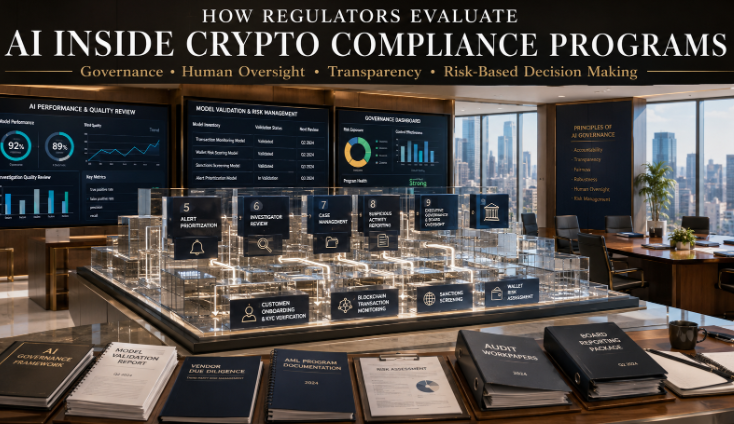
How Regulators May Evaluate AI Inside Crypto Compliance Programs
Artificial intelligence is quickly becoming one of the most talked-about developments in financial crime compliance. Across the digital asset industry, compliance teams are beginning to use AI to streamline investigations, summarize customer due diligence files, prioritize transaction monitoring alerts, identify patterns across blockchain activity, and reduce the administrative burden that comes with managing an increasingly complex compliance program.
These capabilities offer significant promise, particularly for crypto businesses that must manage growing transaction volumes while keeping pace with evolving regulatory expectations. Yet as AI adoption accelerates, another trend is emerging alongside it: regulators are paying closer attention.
The conversation is no longer centered on whether artificial intelligence can improve compliance operations. Instead, regulators are asking a different question: Can organizations demonstrate that AI is being used responsibly within a well-governed compliance program?
That distinction matters.
Artificial intelligence does not reduce an institution’s obligations under anti-money laundering (AML) laws, sanctions regulations, or the broader expectations of a risk-based compliance program. Instead, it introduces another operational capability that must be understood, monitored, and governed. As with any compliance technology, regulators will ultimately evaluate whether AI strengthens the effectiveness of a program without compromising accountability or transparency.
AI Is Becoming Part of Everyday Crypto Compliance
Although artificial intelligence often feels like a brand-new technology, many compliance professionals are already interacting with AI-driven capabilities every day. Modern transaction monitoring platforms, blockchain analytics tools, customer screening solutions, and case management systems increasingly rely on machine learning and intelligent automation behind the scenes.
Rather than replacing investigators, these tools are designed to improve efficiency. AI can organize large datasets, summarize investigative findings, identify behavioral patterns, surface potentially related wallet activity, and help analysts focus on the alerts most likely to represent meaningful risk. Large language models are also beginning to assist compliance teams by drafting investigation summaries, organizing case notes, and synthesizing information collected during enhanced due diligence reviews.
For compliance departments operating under limited resources, these efficiencies are attractive. Investigators spend less time completing repetitive administrative tasks and more time analyzing unusual activity that genuinely requires professional judgment.
However, efficiency alone has never been the standard by which regulators evaluate compliance programs.
Historically, regulatory examinations have focused on whether institutions can demonstrate that their controls effectively identify, assess, and manage financial crime risk. AI does not change that expectation. If anything, it raises the bar by requiring organizations to understand how automated recommendations influence compliance decisions.
Governance Will Define AI in Crypto Compliance
When regulators examine an AI-assisted compliance program, they are unlikely to begin by evaluating the sophistication of the underlying technology. Instead, they will start with governance.
This mirrors the approach regulators have taken for decades with transaction monitoring systems, sanctions screening platforms, and other compliance technologies. The primary concern is not whether a tool uses advanced algorithms but whether management understands how it works, why it was implemented, and how associated risks are controlled.
Organizations should be able to explain why an AI solution was introduced, what compliance challenge it addresses, how its performance is evaluated, and what controls exist to prevent inappropriate reliance on automated outputs. They should also understand where human review occurs and how significant compliance decisions are ultimately approved.
These questions reflect long-standing regulatory expectations surrounding model risk management, vendor oversight, and internal governance. Artificial intelligence simply extends those principles into a rapidly evolving area of compliance technology.
The organizations most likely to succeed during examinations will not necessarily be those using the newest AI platforms. Instead, they will be those capable of demonstrating that artificial intelligence has been thoughtfully integrated into an existing compliance framework with clear oversight and documented accountability.
Human Judgment Remains Essential
Despite rapid advances in artificial intelligence, compliance continues to be a fundamentally human responsibility.
AI can assist investigators by identifying anomalies, recommending customer risk ratings, summarizing investigative findings, or highlighting relationships between blockchain addresses. What it cannot do is exercise legal or regulatory judgment on behalf of an institution.
Determining whether suspicious activity warrants escalation, whether enhanced due diligence should be performed, or whether a customer relationship presents unacceptable risk requires context that extends beyond data alone. These decisions often depend on business purpose, customer behavior, geographic exposure, previous investigative history, and evolving financial crime typologies.
Experienced investigators understand that compliance is rarely a matter of identifying isolated red flags. Instead, it requires evaluating information collectively to determine whether activity is consistent with a customer’s expected behavior and overall risk profile.
Overreliance on AI creates its own operational risk. If investigators begin accepting automated recommendations without thoughtful review, organizations may unintentionally weaken the independent judgment that regulators expect to see within an effective AML program.
Artificial intelligence should enhance human decision-making, not replace it. The strongest compliance programs will continue relying on experienced professionals to validate findings, challenge assumptions, and ensure that important regulatory decisions remain well supported.
Transparency Builds Regulatory Confidence
One of the most significant challenges surrounding artificial intelligence is explainability.
Many AI models produce highly accurate recommendations while offering limited visibility into how those conclusions were reached. For regulated institutions, this lack of transparency can become problematic during examinations or independent audits.
Compliance decisions often need to be explained months—or even years—after they occur. If an investigator cannot clearly articulate why a customer received a high-risk designation or why an alert was closed without escalation, defending that decision becomes considerably more difficult.
Transparency does not require organizations to understand every mathematical calculation behind an AI model. Rather, it requires them to understand how the technology influences investigative workflows, what information it considers, and where human oversight is incorporated before significant compliance actions are taken.
This level of understanding allows institutions to demonstrate that AI supports decision-making rather than replacing it. It also encourages greater confidence among investigators, who are more likely to trust recommendations they can reasonably evaluate and explain.
AI Requires Ongoing Oversight
Implementing an AI solution should never be viewed as a one-time project.
Financial crime continues to evolve as criminal organizations adapt to new controls, blockchain ecosystems mature, and regulatory priorities shift. An AI model trained on historical activity may gradually become less effective if it is not periodically reviewed and updated.
This concept is already familiar within compliance. Transaction monitoring systems require tuning, sanctions screening tools require calibration, and customer risk models require periodic validation. Artificial intelligence deserves the same level of ongoing oversight.
Organizations should regularly evaluate whether AI-assisted workflows continue supporting effective investigations, whether underlying data remains reliable, and whether investigators are using the technology appropriately. Monitoring model performance, validating outputs, and documenting governance decisions should become routine components of an organization’s broader compliance program.
Treating AI as a continuously managed capability rather than a completed implementation project helps reduce operational risk while demonstrating mature governance to regulators.
Third-Party AI Does Not Transfer Responsibility
Most crypto businesses will access artificial intelligence through third-party technology providers rather than developing proprietary models internally.
While this approach accelerates adoption, it does not reduce regulatory responsibility.
Organizations remain accountable for understanding how vendor solutions influence compliance decisions, what data those systems rely upon, how recommendations are validated, and what controls exist to identify potential errors. Effective vendor due diligence should increasingly include questions about AI governance, documentation, testing, update procedures, and independent validation.
As AI becomes more deeply integrated into compliance technology, vendor oversight programs will likely expand to include many of the same governance expectations organizations apply internally.
The Future of AI in Crypto Compliance Will Be Measured by Trust
Artificial intelligence is poised to become a permanent component of crypto compliance, but its long-term success will not be measured by how quickly it processes alerts or how many investigations it helps complete.
Instead, success will be measured by trust.
Regulators will continue evaluating whether organizations maintain strong governance, document meaningful oversight, exercise independent judgment, and preserve accountability as AI capabilities become more sophisticated. These principles are not new; they have long formed the foundation of effective compliance programs.
Organizations that view AI as a tool for strengthening existing compliance frameworks—rather than replacing them—will be better positioned to adapt as regulatory expectations continue to evolve.
As we explored in our previous article, “What Regulators Actually Expect From Crypto Compliance Programs in 2026,” regulators consistently emphasize governance, documentation, and operational effectiveness over technological sophistication. The same philosophy applies here. Artificial intelligence should reinforce those principles, not complicate them.
Similarly, our discussion in “What Recent Crypto Enforcement Actions Reveal About AML Priorities” illustrates how enforcement actions often signal supervisory expectations before formal guidance is issued. Organizations implementing AI today should take the same proactive approach by establishing governance frameworks that reflect existing compliance principles rather than waiting for AI-specific regulations to emerge.
Ultimately, regulators are unlikely to reward organizations simply for adopting artificial intelligence. They will evaluate whether AI helps create a compliance program that is more transparent, more accountable, and more effective at managing financial crime risk. For crypto businesses navigating the next generation of compliance, that distinction may prove far more important than the technology itself.
Strengthen Your AI in Crypto Compliance Program
Artificial intelligence has the potential to make crypto compliance programs more efficient, scalable, and effective, but only when it’s deployed responsibly. As regulators increasingly evaluate how firms govern, validate, and oversee AI-driven compliance tools, organizations should ensure their technology is supported by strong governance, documented controls, and meaningful human oversight.
Looking to implement or strengthen AI in your crypto compliance program? BitAML helps cryptocurrency businesses, stablecoin issuers, fintechs, banks, and payment companies evaluate AI-enabled compliance solutions, develop governance frameworks, and enhance AML, sanctions, fraud, and regulatory compliance programs. Contact us today to learn how we can help your organization harness AI while meeting evolving regulatory expectations.