In Part 1 of this series https://blog.bitaml.com/2026/04/08/stablecoins-aml-risk-moving-beyond-the-headlines-to-practical-controls-for-crypto-companies-part-1-of-2/, we focused on what crypto platforms should do to address AML risks associated with stablecoins.
The core takeaway was straightforward:
While stablecoins now represent a significant share of activity—and risk—too much of the industry conversation remains high-level and nonspecific. Platforms need more than “monitor better” and “enhance controls.” They need more granular, operational direction.
But that was only half the story.
Because if Part 1 was about platform responsibility, Part 2 is about issuer accountability.
And candidly, this is where the conversation needs to mature.
Stablecoin Issuers Are Not Passive Infrastructure
Stablecoin issuers often position themselves as neutral infrastructure—issuance, redemption, and little else.
From a compliance and risk perspective, that framing is incomplete.
Issuers:
- Control minting and redemption
- Maintain reserve structures
- Often retain administrative controls (e.g., freezing capabilities)
- Have network-wide visibility that individual platforms do not
That combination creates unique leverage points for risk mitigation.
And with that leverage comes expectation.
The Gap: Capability vs. Deployment
Many issuers already have:
- The ability to freeze or blacklist wallets
- Visibility into transaction flows
- Relationships with law enforcement
- Internal compliance teams and monitoring capabilities
The issue is not whether these capabilities exist.
It’s whether they are being used consistently, proactively, and transparently.
1. Operationalize Wallet Controls—Don’t Just Maintain Them
Most major stablecoin issuers retain the ability to freeze assets or block addresses.
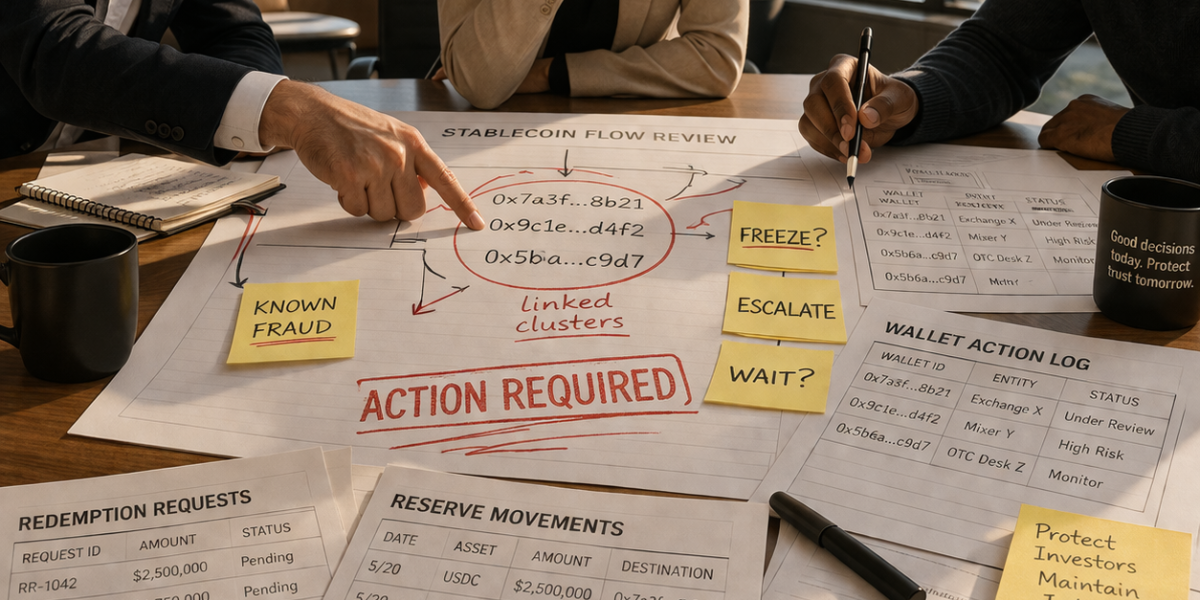
That capability should not be viewed as a last resort—it should be part of a defined control framework.
What This Means in Practice
- Establish clear criteria for when wallet freezes are triggered
- Align triggers with known typologies (fraud, sanctions exposure, scams, etc.)
- Reduce latency between detection and action
Key Point
The industry often debates whether issuers should intervene.
Regulators and law enforcement are increasingly focused on how quickly and effectively they do.
2. Move from Reactive to Proactive Monitoring
Issuers sit at a vantage point that most platforms do not: network-level visibility across flows.
That visibility should translate into proactive risk identification.
Practical Steps
- Monitor large-scale stablecoin flows across clusters and counterparties
- Identify emerging typologies early (e.g., new scam wallet patterns)
- Flag anomalous activity that spans multiple platforms
Where Issuers Can Lead
Platforms often see fragments of activity.
Issuers can see patterns.
That distinction matters.
3. Strengthen Law Enforcement Engagement—With Speed and Structure
“Be more cooperative with law enforcement” is often said—but rarely defined.
Let’s define it.
What Effective Cooperation Looks Like
- Rapid response protocols for lawful requests
- Dedicated points of contact for urgent matters
- Clear internal escalation procedures
- Ability to act quickly when credible threats are identified
Why This Matters
In many fraud and scam scenarios, time is the deciding factor between loss and recovery.
Responsiveness is not just a compliance issue—it is a consumer protection imperative.
4. Increase Transparency Around Actions Taken
One of the simplest ways to build trust is through measured transparency.
Suggested Practices
- Periodic reporting on:
- Wallet freezes
- Blacklisting actions
- Law enforcement cooperation metrics
- High-level summaries of enforcement trends
Benefit
Transparency demonstrates:
- Commitment to compliance
- Willingness to act
- Alignment with broader ecosystem integrity
5. Define and Disclose Risk Appetite
A foundational question that many issuers have not clearly answered:
What types of activity are you willing to support—and what will you actively prevent?
Key Elements of a Risk Appetite Framework
- Jurisdictional exposure thresholds
- Acceptable use cases vs. restricted activity
- Tolerance for indirect exposure to high-risk services
Why This Matters
Without a defined risk appetite:
- Controls become inconsistent
- Enforcement appears arbitrary
- External stakeholders (including regulators) fill in the gaps
6. Align Reserve, Redemption, and Compliance Functions
Stablecoin risk is not limited to blockchain activity.
It extends into:
- Reserve management
- Redemption processes
- Banking relationships
Integration Points
- Ensure AML controls are aligned across on-chain and off-chain activity
- Monitor redemption patterns for indicators of illicit use
- Coordinate between compliance, treasury, and operations teams
Key Risk
Disjointed controls create blind spots—especially at the fiat interface.
7. Implement Coin-Level Risk Governance (Yes, Even for Your Own Coin)
In Part 1, we emphasized the need for platforms to maintain a coin due diligence framework.
Issuers should hold themselves to at least the same standard.
This Includes
- Formal internal risk assessments of the stablecoin itself
- Ongoing evaluation of how the asset is being used in the market
- Identification of emerging misuse patterns
Critical Addition
Define issuer-specific mitigating controls, such as:
- Enhanced monitoring for certain transaction types
- Automatic triggers tied to behavioral indicators
- Escalation protocols tied to usage patterns
8. Treat Compliance as a Core Product Function—Not a Constraint
This is perhaps the most important shift.
Compliance should not be viewed as:
- A regulatory obligation
- A reactive or defensive function
- A cost center
It should be treated as:
A core component of the product itself
Why?
Because stablecoins are not just financial instruments—they are financial infrastructure.
And infrastructure that does not manage risk effectively does not scale sustainably.
Shared Responsibility—But Not Equal Responsibility
It is true that AML risk management in the stablecoin ecosystem is a shared responsibility:
- Platforms monitor users
- Analytics firms provide intelligence
- Regulators set expectations
But issuers occupy a unique position.
They are not just participants—they are enablers of the system.
And as stablecoins continue to account for a significant share of activity, expectations for issuers will continue to rise.
Appropriately so.
Final Thoughts: From Capability to Commitment
If Part 1 was about moving platforms from awareness to execution, Part 2 is about moving issuers from capability to commitment.
The tools already exist:
- Monitoring
- Freezing
- Engagement
- Oversight
The next step is consistency, clarity, and accountability in how those tools are used.
Interested in strengthening your AML framework or preparing for evolving regulatory expectations?
We’d welcome the conversation. Contact us at info@bitaml.com to learn more.